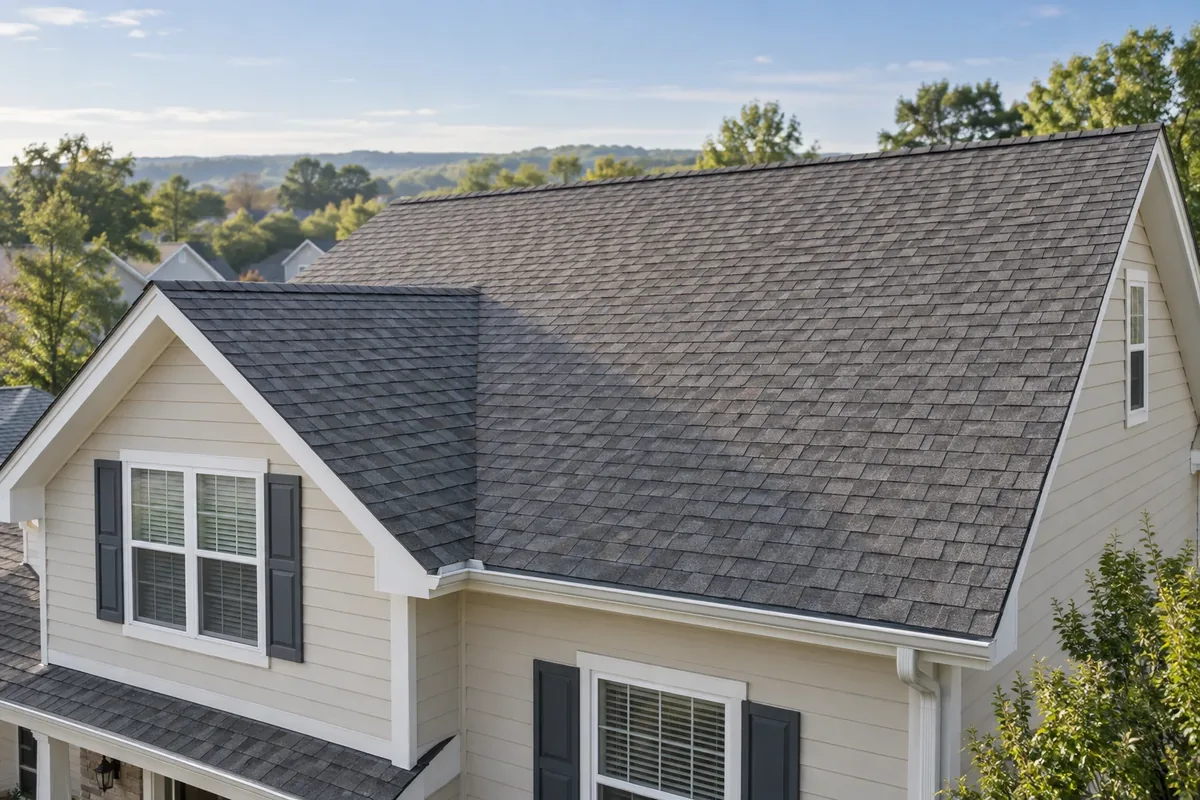
A roof can be protecting the home today and still create an insurance problem. That is because physical service life, manufacturer warranty, and insurance underwriting age are three different things.
A homeowner may see an older roof that is not leaking. An insurer may see an increased probability of wind, hail, water, or replacement-cost loss during the next policy period. The resulting decision may depend on material, shape, slope, ventilation, condition, installation, documentation, prior claims, location, and the rest of the property.
This guide explains how those pieces fit together. It does not rank one roof as universally best. It shows why two roofs of the same age can receive different insurance treatment and what a homeowner can do after a roof-related decline or non-renewal.
The Five Questions That Matter Most
When a roof affects homeowners insurance, separate the issue into five questions:
- What roof system is actually installed?
- How old are the covering and supporting components?
- What condition are they in now?
- What is the insurer willing to cover, limit, or exclude?
- What documentation or work could change the decision?
A broad statement such as “your roof is too old” does not answer all five.
A Roof Is a System, Not Just the Visible Material
The visible covering works with the deck, underlayment, flashing, fasteners, structural connections and drainage. Attic moisture control, insulation and ventilation can affect what happens beneath it.
A durable covering cannot compensate for failed flashing or rotten decking. A newer covering installed over hidden deterioration differs from a complete tear-off with documented deck repairs. Ask how the policy defines the roof and which components its limitation affects.
Roof Shapes and Why They Matter
Gable roofs have two main slopes and triangular end walls. Hip roofs slope toward the walls on all sides. Low-slope roofs depend on reliable drainage and an appropriate membrane or other approved system. Mansard, gambrel, shed and mixed roofs add transitions that need careful detailing.
Shape influences wind pressures, water flow, access and replacement complexity. Connections, material and condition remain essential. Use the roof shapes guide for design-specific questions rather than treating one shape as universally best.
Broad Roof Material Comparison
No lifespan number is guaranteed. These are broad planning concepts, not insurance eligibility rules.
| Material | General service-life pattern | Common insurance concern |
|---|---|---|
| 3-tab asphalt shingles | Often shorter than architectural shingles | Age thresholds, wind damage, granule loss, curling, replacement frequency |
| Architectural asphalt shingles | Often longer than 3-tab when properly installed | Age, condition, prior claims, ventilation, settlement changes |
| Standing-seam metal | Long service-life potential | Replacement cost, hail appearance, panel matching, specialized repair |
| Exposed-fastener metal | Long potential with maintenance | Fasteners, washers, corrosion, sealant, panel movement |
| Clay or concrete tile | Covering can last several decades | Underlayment age, broken units, walking damage, matching, weight |
| Natural slate | Quality slate can last many decades or longer | Fasteners, flashing, skilled repair, weight, replacement cost |
| Wood shake or shingles | Highly variable by material, climate, treatment, and maintenance | Fire and wildfire exposure, splitting, rot, carrier appetite |
| Synthetic products | Varies significantly by manufacturer and product | Limited long-term field history, product identification, repair and matching |
| Low-slope membrane | Varies by system and maintenance | Ponding, seams, punctures, drainage, wet insulation, installation records |
The broad material category is only the start. Product, installation, climate, slope, deck, underlayment, flashing, ventilation, maintenance, and storm history determine the actual result.
Asphalt Shingles
Asphalt shingles are widely used and familiar to insurers and contractors. The two common categories are 3-tab and architectural or laminated shingles.
Insurers may look for:
- Installation date
- Product type
- Number of layers
- Curling, cracking, lifting, or missing shingles
- Granule loss
- Patching
- Storm claims
- Deck and ventilation condition
A roof may remain functional after it falls outside one carrier’s age guideline. Another market may consider an inspection, actual cash value, a roof schedule, or a limitation.
Read Asphalt Shingle Roof Lifespan.
Metal Roofs
Metal can have a long service life, but “metal roof” includes very different systems.
Standing seam, exposed-fastener panels, metal shingles, stone-coated products, aluminum, steel, copper, and zinc differ in attachment, coating, corrosion, repair, and replacement cost.
Inspection concerns may include:
- Loose or backed-out fasteners
- Failed washers
- Open seams
- Corrosion
- Coating damage
- Improvised sealant repairs
- Hail dents
- Panel matching
- Roof-over installation
Metal is not automatically cheaper to insure, and cosmetic hail damage may be excluded even when functional damage remains potentially covered.
Read Metal Roofs vs. Asphalt Shingles.
Clay and Concrete Tile
Tile covering can remain durable while underlayment, flashing, fasteners, battens, mortar, or deck age beneath it.
An underwriter may ask whether a project replaced:
- Only broken tiles
- Underlayment and flashing through a lift and relay
- The entire roof system
- Decking or structure
Tile is heavy, can break from improper walking, and may be difficult to match. A material-specific inspection can be more useful than a general roof report.
Natural Slate
Quality slate can have exceptional longevity. The roof can still fail because of fasteners, flashing, broken units, poor prior repairs, incompatible replacement slate, deck, or structure.
A few slipping slates do not automatically mean the entire roof has failed. A broad age number also does not prove the roof is sound. Use a professional experienced with natural slate.
Read Tile and Slate Roof Lifespan and Insurance.
Wood Roofs
Wood shake and shingles can be attractive and serviceable when the material, installation, treatment, climate, and maintenance are appropriate. Insurance concerns may include:
- Fire and wildfire exposure
- Splitting and curling
- Rot or moisture retention
- Moss and debris
- Treatment documentation
- Roof age
- Limited carrier appetite
A fire-resistant treatment or classification does not guarantee eligibility in a high-wildfire area. Insurers may evaluate the full property, vegetation, access, community exposure, vents, decks, siding, and nearby structures.
Synthetic Roofing
Synthetic slate, shake, and other composite products can reduce weight or replicate traditional materials. Product quality and field history vary.
Documentation should include:
- Manufacturer
- Product line
- Installation date
- Product approvals
- Warranty
- Contractor
- Repair availability
- Matching availability
An underwriter may have difficulty evaluating an unidentified product from an aerial image. Accurate documentation can prevent it from being misclassified.
Ventilation, Heat, and Moisture
A roof may deteriorate from the underside.
In a traditional vented attic, lower intake and upper exhaust work with air sealing and insulation to manage heat and moisture. A properly designed unvented conditioned attic uses a different assembly and should not be “fixed” by adding random vents.
Poor performance can contribute to:
- Condensation
- Damp insulation
- Mold-like growth
- Rusted fasteners
- Deteriorated deck
- Ice dams
- Premature aging
- Repeated ceiling stains
The insurance concern is usually the damage and future loss potential rather than a simple vent count.
Read Roof Ventilation and Insurance.
What Shortens Roof Service Life
Installation errors, incompatible repairs, storm damage, climate, blocked drainage and unresolved attic moisture can shorten service life. The effect depends on the assembly. A fastener problem on metal calls for a different repair than a brittle underlayment beneath tile.
Keep repair records and ask the contractor to identify the underlying cause. Repeated patches without a durable correction may leave the same risk in place.
Warning Signs an Insurer May Notice
- Missing or lifted covering
- Curling, cracking, or breaking
- Heavy granule loss
- Rust or open metal seams
- Broken or slipped tile or slate
- Ponding water
- Failed flashing
- Sagging
- Repeated patching
- Debris or tree contact
- Active leakage
- Ceiling stains
- Deteriorated deck
- Moisture in the attic
- Unrepaired claim damage
A photograph does not always identify the cause. Ask for the inspection report and obtain a specific diagnosis.
Read Signs Your Roof Is Nearing the End of Its Life.
What Insurance Companies May Do
An insurer may accept the roof, ask for records, require work, offer a different settlement method or exclude particular damage. A decline from one carrier does not establish that no other option exists.
| Term | What to understand |
|---|---|
| Replacement cost | Payment for a covered loss follows replacement-cost conditions, limits and deductibles |
| Actual cash value | Depreciation may reduce the payment for a covered roof loss |
| Roof payment schedule | Payment depends on a stated schedule, often using age and material |
| Roof or peril exclusion | Specified property or causes of loss receive no coverage under the affected terms |
| Cosmetic limitation | Appearance-only damage may be excluded or restricted |
Read the roof exclusion insurance guide for the complete comparison. The endorsement can also affect water damage below the roof, so review the claims guide before assuming the interior is covered.
Roof Age, Warranty, and Insurance Age
Warranty
A warranty is a contract that may cover a product or workmanship under specific conditions. It can be prorated and may exclude labor, storm damage, ventilation problems, or improper installation.
Service life
Service life is how long the roof performs under real conditions.
Insurance age
Insurance age is the point at which a carrier changes eligibility, inspection, or settlement terms.
A “lifetime” warranty does not require an insurer to provide replacement-cost coverage forever. A roof beyond one insurer’s guideline is not automatically uninsurable everywhere.
Documentation That Can Help
Create a roof file containing:
- Installation contract and invoice
- Permit and final inspection
- Product and manufacturer
- Warranty
- Photographs during installation
- Deck and underlayment records
- Ventilation or insulation records
- Repair invoices
- Current inspection
- Prior claim documents
- Proof of completed repairs
- Non-renewal or cancellation notice
- Proposed policy and endorsements
For a mixed roof, document each section separately.
What to Do After a Roof-Related Non-Renewal
- Record the effective date and stated reason.
- Ask for the inspection report, photographs, or aerial evidence.
- Verify roof age and material.
- Correct active leaks and unsafe conditions.
- Obtain a specific current inspection.
- Do not cancel existing coverage prematurely; arrange replacement before its expiration whenever possible.
- Compare carriers and policy structures.
- Check lender requirements before accepting a major exclusion.
- Review the complete policy, not just the quote summary.
- Build a realistic long-term roof plan.
A specialist may be able to compare flexible standard, specialty, FAIR Plan, or limited-coverage options, but coverage is never guaranteed.
Questions to Ask About Any Proposed Policy
Confirm the roof settlement method, excluded causes, definition of roof components, resulting water damage, cosmetic and matching terms, deductibles and any repair deadline. Ask what would be required to remove a limitation later and whether the lender will accept the exact policy.
Build a Roof Plan Before a Crisis
A homeowner has more options before the policy expires or the roof leaks.
A practical plan may include:
- Verifying roof age
- Obtaining a condition report
- Correcting drainage and flashing problems
- Preserving permits and invoices
- Comparing repair and replacement proposals
- Budgeting or arranging financing
- Understanding policy settlement terms
- Checking lender requirements
- Shopping before the non-renewal deadline
The goal is not to replace every older roof automatically. It is to understand the real condition and avoid being forced into a rushed decision with incomplete information.
Choose the Guide That Matches Your Situation
Use the material guides for age, maintenance and inspection questions. Use the exclusion guide when comparing policy terms and the claims guide when damage has already happened. Start with the roof exclusion guide if your insurer has proposed a limitation, or claims with a roof exclusion if damage has already happened.
Request a roof exclusion quote if roof age or condition is making insurance difficult to find.
Availability and coverage are not guaranteed. Quote requests are unavailable for properties in California, Hawaii, New York and Rhode Island.
Frequently Asked Questions About Roof Types and Insurance
What roof type is easiest to insure?
There is no universally easiest material or shape. A newer, well-installed, documented, and maintained roof usually fits more guidelines, but location, claims, insurer rules, and the rest of the property matter. Metal or tile may have longer service-life potential without receiving a longer insurance age limit; material alone does not guarantee terms.
Do insurance companies require roof replacement at 15 or 20 years?
There is no national rule requiring every roof to be replaced at one age. Individual insurers may use age guidelines, inspection requirements, settlement changes, or material-specific rules.
Can an inspection and roof records help an older roof qualify?
A current inspection may help a flexible underwriter assess condition and repairability, but it cannot override a firm age rule. Include clear photographs, the installation invoice, permit, repair invoices, claim records, and any non-renewal notice. Review proposed endorsements alongside those records. Documentation clarifies the issue without guaranteeing approval.
Can poor ventilation cause a roof decline?
An insurer may act on moisture damage, deteriorated decking, active leakage, premature aging, or mold-like growth associated with a poorly performing attic. The actual cause and repair should be documented.
What is the difference between ACV and a roof exclusion?
Actual cash value generally allows payment for a covered loss after depreciation. A roof exclusion may provide no payment for excluded damage, while a payment schedule or peril limitation creates still different results.
Will a lender accept limited roof coverage?
Possibly, but requirements vary by lender and servicer. Provide the exact declarations and endorsements and obtain approval before relying on a significant limitation.
About this information
This is general education. RoofExclusion.com provides information and a way to request assistance, and does not issue policies or decide claims. Coverage, eligibility, repair requirements and lender acceptance depend on the property, insurer, state and actual policy. Use qualified roofing and insurance professionals for decisions about your home.
Sources
- GAF: roof repair, replacement and service-life guidance
- U.S. Department of Energy Building America: vented and unvented attics
- Tile Roofing Industry Alliance: installation guides
- NAIC: actual cash value and replacement cost